The Problem With How Many Parts Washers Get Built
When manufacturers begin evaluating industrial parts washing equipment, they often assume that buying from a “manufacturer” means buying from a company that designs, engineers, and builds the entire system.
In many cases, that assumption isn’t accurate.
Some equipment suppliers function primarily as assemblers. They may engineer portions of the machine internally, while fabrication is outsourced to one company, controls programming is handled by another, and software development is performed by yet another vendor.
Others take an even simpler approach, they import equipment built overseas and resell it under their own brand with little or no involvement in the original design or manufacturing process.
These business models can reduce upfront costs, but they also create an important question: who truly owns the machine?
Industrial parts washers are highly integrated systems where every component affects overall performance. Spray pressure influences cleaning effectiveness. Filtration impacts solution life. Controls determine process consistency. Drying performance affects downstream quality. Every subsystem must work together to deliver repeatable results.
When the design and manufacturing responsibilities are spread across multiple organizations, or when the supplier didn’t build the equipment in the first place, troubleshooting can become complicated.
If cleaning performance changes, is the issue mechanical? Electrical? Software? Process-related?
Instead of one engineering team solving the problem, the equipment supplier may be contacting the fabricator. The fabricator may point to the controls integrator. The controls integrator may review the software. If the machine was imported, the supplier may need to work through the overseas manufacturer before a solution can even begin.
Meanwhile, production doesn’t stop.
For manufacturers, every hour of downtime affects schedules, productivity, and customer commitments.
This is exactly the problem that vertical integration is designed to solve.
When one company designs, engineers, fabricates, programs, assembles, and supports the entire system, there is a single source of accountability. The engineering team understands how every subsystem interacts because they created the complete solution. Problems can be diagnosed more quickly, modifications can be implemented more efficiently, and support isn’t dependent on coordinating multiple vendors or international supply chains.
Vertical integration isn’t simply about building more components in-house. It’s about maintaining ownership of the entire process, from initial engineering through manufacturing, installation, and long-term support.
For manufacturers investing in industrial cleaning equipment that will operate for years or even decades, that level of ownership often makes the difference between a supplier that sells a machine and a partner that stands behind it.
Why Manufacturers Ask About Vertical Integration
Manufacturers are rarely interested in vertical integration for its own sake.
What they care about is consistently achieving cleanliness requirements efficiently and reliably.
Cleaning performance is never determined by a single component. Nozzle placement affects coverage. Chemistry affects contaminant removal. Filtration affects system performance. Controls affect consistency. Drying affects downstream operations.
Every variable influences the next.
When those systems are designed, fabricated, programmed, and validated by separate organizations, coordination becomes more difficult. When they are developed by a single team working toward the same process objective, the result is typically a more reliable and predictable cleaning process.
Vertical integration is ultimately about reducing complexity and creating a direct path from engineering intent to cleaning performance.
What Vertical Integration Actually Means
Vertical integration means a manufacturer owns and controls every critical phase of a system’s design, build, validation, and support under one roof.
For industrial parts washing systems, those critical disciplines include:
- Process engineering
- Mechanical engineering
- Fabrication and metalwork
- Controls engineering
- Automation integration
- Software development
- Testing and validation
- Long-term technical support
A vertically integrated manufacturer maintains all of these capabilities internally, allowing engineering, manufacturing, and support teams to work together throughout the life of a project.
This is fundamentally different from an outsourced assembly model.
When engineering, fabrication, controls, and software teams operate within the same organization, information moves quickly. A process engineer adjusting nozzle placement can immediately collaborate with controls engineers responsible for cycle sequencing. A fabrication issue discovered during manufacturing can be reviewed directly with the engineering team before it affects production schedules.
Those interactions happen naturally when everyone shares responsibility for the same outcome.
A Different Approach for More Than 65 Years
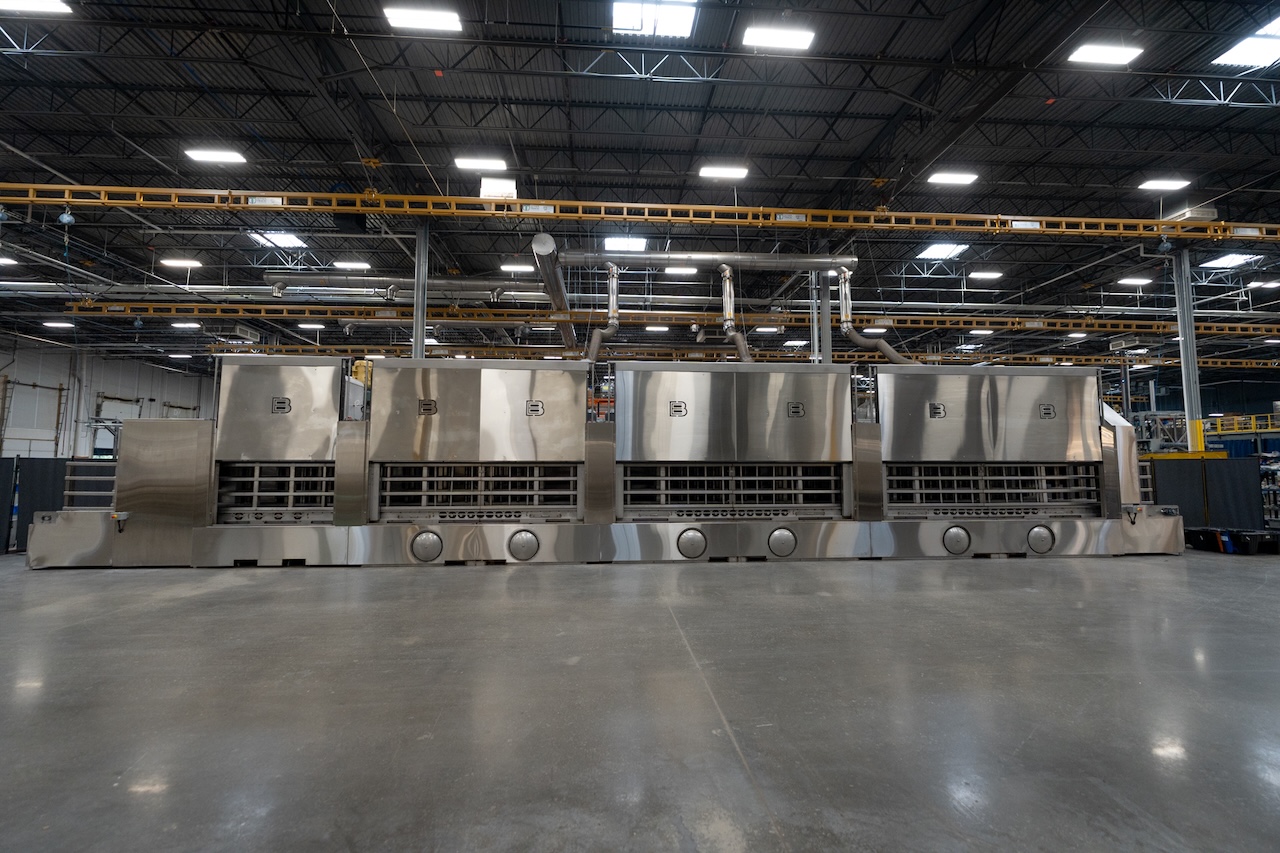
For more than 65 years, Better Engineering has designed and manufactured industrial cleaning systems for manufacturers worldwide.
With more than 25,000 systems installed, the company has served virtually every industry, including automotive, aerospace, medical device, pharmaceutical, food processing, electronics, defense, energy, and general manufacturing.
Over decades of application development, one lesson has remained consistent: cleaning performance depends on how well every part of the system works together.
That understanding has shaped Better Engineering’s vertically integrated operating model.
Engineering, fabrication, controls development, automation integration, software development, testing, and validation are all performed internally, allowing a single team to take responsibility for the entire cleaning process from initial application review through long-term support.
The Six Capabilities That Define Better Engineering’s Model
In-House Engineering and Process Design
Every project begins with a process engineering review.
Part geometry, contamination type, cleanliness requirements, production volumes, and downstream processes are evaluated before a system is designed.
Better Engineering approaches industrial cleaning as a controlled manufacturing process. The objective is not simply to wash parts. The objective is to consistently and efficiently meet a defined cleanliness specification.
The cleaning system is engineered to control the variables that influence that outcome.
Fabrication and Manufacturing
Frames, tanks, enclosures, conveyors, and structural components are fabricated internally.
Maintaining manufacturing operations in-house helps preserve dimensional accuracy, eliminates communication gaps between engineering and fabrication, and allows design improvements to be implemented quickly when needed.
The result is a closer connection between design intent and final construction.
Controls Engineering
PLC programming, HMI development, sensor integration, cycle logic, and process monitoring are developed internally.
Controls are not treated as an add-on completed at the end of a project. They are developed alongside the mechanical and process design from the beginning.
Because controls engineers work directly with process and mechanical engineers throughout development, modifications can be implemented quickly and accurately. When process requirements change, the team responsible for software and automation is already part of the conversation.
Automation Integration
Many manufacturing environments require cleaning systems to communicate directly with upstream and downstream production equipment.
Better Engineering designs and integrates systems that work with:
- Robotics
- Assembly equipment
- Packaging systems
- Plant automation networks
Because automation integration is handled internally, manufacturers receive a system engineered to function as part of the broader production process rather than as a standalone piece of equipment.
Proprietary Software
Better Engineering develops proprietary technologies, including Aqua Insights and RapidSupport, to help manufacturers gain greater visibility into system performance and support needs.
Data logging, cycle traceability, alarm management, process monitoring, and remote support capabilities are developed internally to meet the needs of modern manufacturing environments.
For industries where documentation and compliance are critical, access to process data can be just as important as cleaning performance itself.
Testing, Validation, and Process Development
Before a system is engineered, Better Engineering works to understand the complete cleaning challenge.
Applications are evaluated based on part geometry, contamination type, cleanliness requirements, production rates, and downstream process needs.
Testing is performed using actual production parts and contaminants whenever possible.
Available testing capabilities include:
- Millipore particulate analysis
- Water-break-free testing
- Microbial testing
- Gravimetric analysis
- Dyne level testing
- Process chemistry evaluation
- Drying performance verification
The goal is not simply to determine whether a part can be cleaned.
The goal is to establish a repeatable process capable of producing measurable results in production environments.
Systems are then tested and validated prior to shipment to verify performance against application requirements.
How Better Engineering Develops a Cleaning Process
Every application follows a structured, ISO-certified process designed to reduce risk and improve outcomes.
This includes:
- Application review and contamination analysis
- Part sample evaluation
- Laboratory testing and process development
- Cleanliness verification and documentation
- System engineering and design
- Controls and automation integration
- Factory acceptance testing
- Installation, startup, and long-term support
This disciplined approach helps ensure the final solution is built around the customer’s requirements rather than forcing an application into a standard machine configuration.
Why This Model Produces Better Outcomes
The practical benefits of vertical integration appear in several areas that manufacturers consistently care about.
Faster Delivery and Fewer Surprises
When engineering, fabrication, controls, software, and testing teams work within the same organization, project schedules are easier to coordinate.
There are fewer external dependencies, fewer communication delays, and fewer opportunities for critical information to be lost between vendors.
Single Point of Accountability
When support is needed, there is one organization responsible for the complete system.
The same team maintains the engineering drawings, fabrication history, controls logic, software architecture, and process documentation.
Manufacturers spend less time coordinating between vendors and more time solving problems.
Tighter Quality Control
The cost of an improperly engineered cleaning system rarely appears on the equipment quote.
It often appears later as coating failures, residual contamination, trapped moisture, corrosion, assembly issues, or increased rework.
Vertical integration shortens the feedback loop between design intent and cleaning performance, which is where quality is ultimately determined.
Lower Total Cost of Ownership
The true cost of a cleaning system includes utilities, chemistry consumption, maintenance labor, downtime, replacement parts, and long-term support.
Systems engineered, validated, integrated, and supported by a single organization often perform more efficiently throughout their service life.
Where Vertical Integration Matters Most
The importance of vertical integration increases as cleaning requirements become more demanding.
In aerospace manufacturing, systems may need to remove hydraulic fluids, machining oils, carbon deposits, and microscopic particulates while meeting strict cleanliness and documentation requirements.
In medical device production, cleaning processes often support particulate removal, bioburden reduction, and validated manufacturing protocols, in which repeatability directly affects regulatory compliance and patient safety.
In automotive manufacturing, contaminants such as machining chips, cutting fluids, and residual oils can affect coating adhesion, assembly quality, and component performance over thousands of production cycles.
In pharmaceutical and food processing environments, hygienic design, microbial control, traceability, and documented process validation are often essential requirements.
In each of these applications, cleaning performance depends on the interaction between spray pressure, chemistry concentration, nozzle placement, filtration capacity, temperature, dwell time, drying performance, and controls logic.
Managing those variables through one integrated team reduces complexity and helps minimize risk.
What “Turnkey” Should Actually Mean
The term “turnkey” appears frequently in industrial equipment marketing.
In practice, the definition can vary significantly.
A true turnkey parts washing system is engineered for the application, integrated into the production environment, validated against cleanliness requirements, and supported by the same organization that designed and built it.
Engineering, fabrication, controls, automation, software, testing, and validation all contribute to that outcome.
When any of those responsibilities are divided among multiple vendors, additional complexity is introduced.
Turnkey should mean one team, one process, and one source of accountability.
Let’s Evaluate Your Application
Every cleaning challenge is different.
The most effective solution begins with understanding the parts, contaminants, cleanliness requirements, production goals, and downstream processes involved.
Better Engineering’s engineering and applications teams can evaluate your parts, perform testing, and recommend a solution based on measurable cleaning performance.
Submit a sample part, schedule a process review, or contact Better Engineering to discuss your application.