Challenge
The existing cleaning process required significant manual handling, making it difficult to maintain consistent results across production batches. Variability in cleanliness created potential downstream issues, while the labor-intensive nature of the process increased costs and limited throughput.
A solution was needed to standardize cleaning performance, reduce operator dependency, and integrate seamlessly into the existing workflow.
Approach
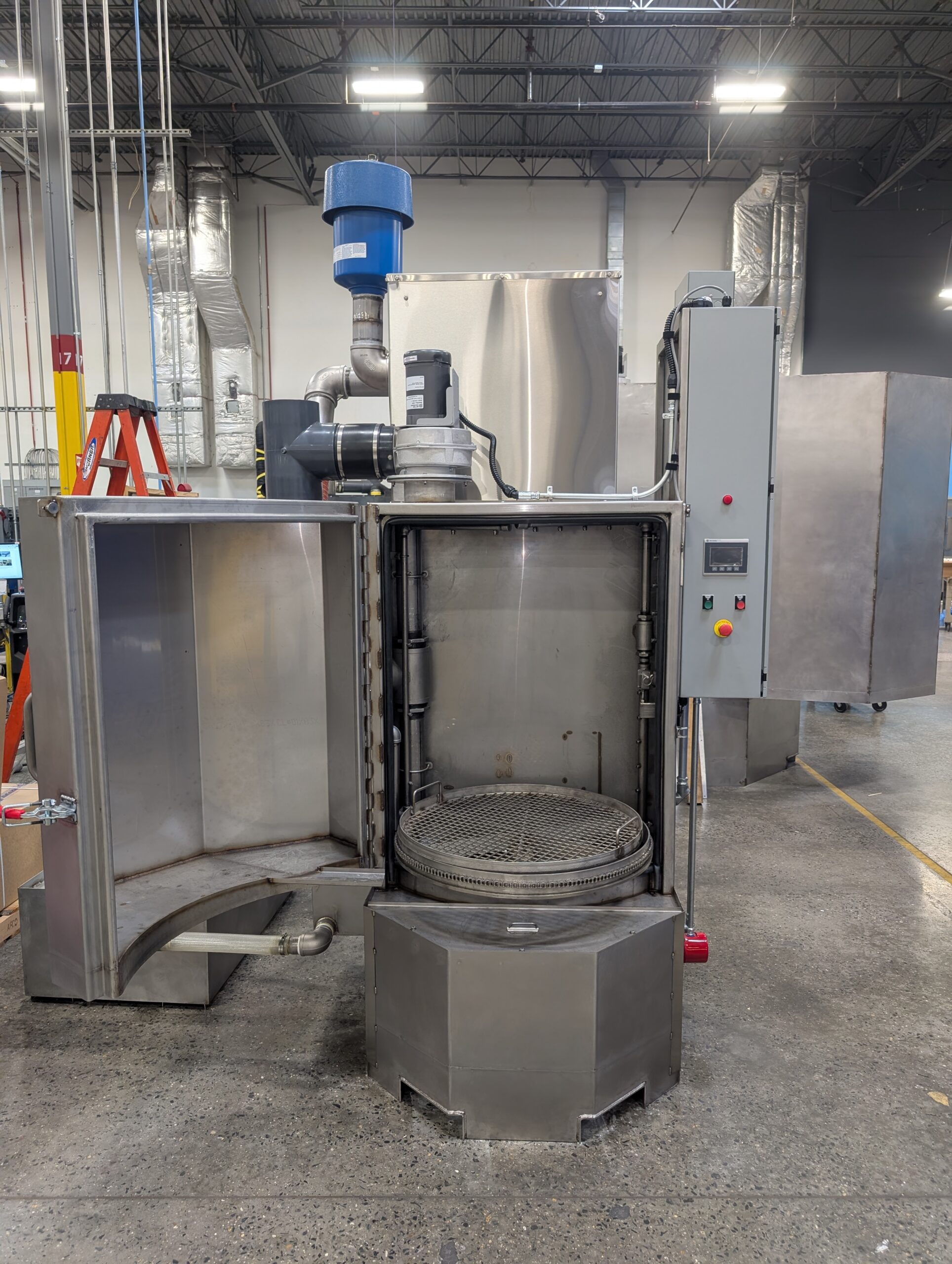
Better Engineering implemented a fully automated cabinet parts washer to meet the application requirements. Key design and engineering elements included:
● Single-chamber automated cleaning. Wash, rinse, and dry stages are completed in one enclosed cycle, eliminating manual transfers between steps and ensuring a controlled, repeatable cleaning environment.
● Turntable-based spray coverage. A fixed rotating turntable works in combination with multi-directional spray manifolds to deliver consistent, full-surface coverage, ensuring all parts are evenly cleaned regardless of geometry or orientation.
● High-performance pump system. A vertical seal-less pump provides steady flow and pressure throughout the cycle, maintaining consistent cleaning energy and reliable removal of soils and contaminants.
● Integrated oil and particulate filtration system. The Purifier filtration design captures debris, oils, and particulates before they can recirculate, helping extend solution life and maintain cleaning effectiveness over extended operation.● Operator-focused design. The front-loading configuration with a fixed turntable improves ergonomics, reduces lifting strain, and simplifies loading and unloading within existing production work cells.
Results
The cabinet part washer introduced measurable improvements across cleaning performance, labor efficiency, and overall process reliability.
Operational performance and highlights
● Cycle time reduction and throughput gains: Automated cleaning cycles consistently run within a 10–15 minute window, enabling faster turnaround of parts and supporting steady production flow without bottlenecks.
● Improved cleaning consistency: Controlled wash parameters, uniform spray coverage, and integrated filtration deliver repeatable, high-quality results from cycle to cycle, reducing variability and rework.
● Labor reduction and efficiency: Automation significantly reduces the need for manual handling and operator intervention, allowing personnel to focus on higher-value tasks within the production process.
● Part quality and readiness: Parts exit the system clean and dry, eliminating secondary handling steps and ensuring components are immediately ready for downstream operations or assembly.
● Process reliability and control: The enclosed, automated system standardizes cleaning conditions, improving predictability and reducing the risk of inconsistencies that can impact production quality.
Business impact
By replacing a manual and inconsistent cleaning process with an automated system, operations became more predictable, efficient, and scalable. The result is improved productivity, reduced labor dependency, and a more reliable cleaning process that supports long-term manufacturing performance.
Conclusion
The decision to implement the cabinet part washer was driven by the need for a more controlled, repeatable, and efficient cleaning process that could support precision manufacturing requirements. Rather than continuing to rely on manual methods that introduced variability and inefficiency, the new system established a standardized approach to cleaning that delivers consistent results with minimal operator involvement. By combining automated wash, rinse, and dry stages in a single chamber with robust spray coverage, filtration, and ergonomic design, the system not only improved cleaning quality but also streamlined workflow and reduced labor demands. The result is a reliable, scalable solution that ensures parts are consistently cleaned and ready for production, helping maintain operational efficiency and supporting long-term manufacturing performance.
Interested in finding your solution? Contact us for more information, a facility tour, or free part testing.