IMMERSION AND ULTRASONIC PARTS CLEANING
IMMERSOSONIC S-22 & S-32 IMMERSION PARTS WASHERS
Clean beyond the surface. ImmersoSonic immersion parts washers fully submerge and agitate components in a heated aqueous cleaning solution, reaching blind holes, internal passages, recesses, and complex geometries. Automation is available for high-volume applications.
66 years
Designing Cleaning Systems
25,000 +
Machines Sold Worldwide
0 Solvents
100% Aqueous Cleaning
100%
Engineered In-House in Joppa, MD
PRECISION CLEANING FOR COMPLEX PARTS
When contamination settles inside blind holes, threads, internal passages, and recessed features, cleaning requires more than line-of-sight spray coverage. Better Engineering ImmersoSonic immersion parts cleaners fully submerge components in a heated aqueous cleaning solution, allowing chemistry, temperature, and mechanical action to reach surfaces that are difficult to access with spray alone.
Powered vertical platform agitation moves submerged parts through the solution to improve fluid exchange and help flush away oils, chips, carbon, fines, and loosened contaminants. For applications requiring more aggressive cleaning, ultrasonic cleaning can be added to introduce cavitation throughout the bath, helping clean intricate features, delicate geometries, and hard-to-reach surfaces.
ImmersoSonic systems can also be configured with filtration, oil removal, rinsing, drying, and automated material handling to create a complete cleaning process around your parts, contamination profile, and cleanliness requirements.
Standard Models at a Glance
| Specifications | IMMERSOSONIC S-22 | IMMERSOSONIC S-32 |
|---|---|---|
|
Platform Size
|
22″ × 14″ x 14”
|
32″ × 24″ X 14” |
|
Ultrasonics |
Optional |
Optional |
|
Best For |
Smaller components and baskets |
Larger components and baskets |
|
Drying |
Optional, heated or vacuum drying |
Optional, heated or vacuum drying |
SEE IMMERSION CLEANING IN ACTION
See how an immersion washer combines full submersion with powered vertical agitation to move cleaning solution through complex part features and flush away loosened contaminants.
BUILT FOR PARTS WHERE EVERY SURFACE MATTERS
Aerospace & Defense
Auto & EV
General MFG.
Medical Devices
WHEN GEOMETRY MAKES CLEANING COMPLICATED
From precision-machined components and manifolds to housings, castings, valves, and assemblies, immersion cleaning surrounds the entire part, reaching surfaces conventional cleaning methods struggle to access.
Resources for Operations & Plant Leaders
Explore the processes, applications, and technologies behind effective immersion and ultrasonic cleaning.
Ultrasonic Immersion WASHER FAQS
How does an immersion parts washer work?
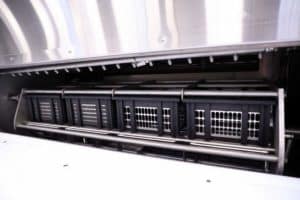
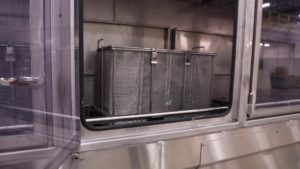
An immersion parts washer completely submerges components in heated aqueous cleaning solution, allowing the chemistry to contact exposed surfaces as well as recessed and difficult-to-access features. ImmersoSonic systems add powered vertical agitation to move the parts through the bath, improving solution exchange and helping flush loosened contamination from complex geometries.
What's the difference between the ImmersoSonic S-22 and S-32?
The primary difference is platform size. The S-22 has a 22″ × 14″ platform, while the S-32 increases the platform to 32″ × 24″ for larger components and baskets. Selecting the appropriate model also depends on part dimensions, weight, soil, cleanliness requirements, production volume, and the required cleaning process.
How does an ultrasonic parts washer clean parts?
An ultrasonic parts washer introduces high-frequency sound energy into the cleaning solution, creating microscopic cavitation bubbles. As those bubbles form and collapse, they produce cleaning action across submerged surfaces, including small crevices, holes, threads, and intricate features that can be difficult to reach mechanically. For ImmersoSonic systems, ultrasonics can be incorporated when the application requires this additional cleaning action.
Can ImmersoSonic systems be automated?
Yes. ImmersoSonic immersion parts cleaning machines can be configured with automated material handling and multi-stage processing based on production requirements. Options can include automated basket transfer, overhead handling, robotic loading and unloading, additional rinse stages, filtration, oil separation, and drying.
NOT SURE WHICH CLEANING PROCESS YOUR PARTS NEED?
Part geometry, soils, cleanliness requirements, basket size, throughput, and downstream processes all influence whether agitation, ultrasonics, or a combination of cleaning methods makes sense. Test cleaning can help determine the process before the system is configured.