
When manufacturers evaluate industrial cleaning systems, the conversation almost always starts with machine specifications.
How much spray pressure does the system generate? What temperature does it operate at? How large is the tank? How much ultrasonic power is available?
These are important questions. But they are not the most important question. The most important question is much simpler:
How do you know the parts are actually clean?
In quality-critical industries, cleanliness is not a matter of appearance. It is a measurable specification, just like a dimensional tolerance or a surface finish requirement.
Automotive manufacturers rely on standards such as ISO 16232 and VDA 19 to measure particulate contamination. Aerospace manufacturers require documented cleaning processes and validation protocols that support NADCAP requirements. Medical device, pharmaceutical, and food manufacturers depend on repeatable cleaning processes that can be verified and audited.
Across these industries, cleanliness is never assumed.
The Problem With Spec-First Thinking
When evaluating industrial cleaning systems, manufacturers naturally compare equipment specifications: spray pressure, flow rate, pump capacity, tank size, ultrasonic power, heating capacity, conveyor speed, and drying performance.
These metrics are important because they describe what a machine is designed to deliver. But they don’t answer the question that ultimately matters:
Will this process consistently produce parts that meet our cleanliness specification?
The answer cannot be found on a product data sheet.
Consider two cleaning systems with nearly identical specifications. Both operate at the same temperature, use similar chemistry, generate comparable spray pressure, and offer similar filtration capabilities. Yet one consistently passes cleanliness validation while the other struggles to meet particulate or residue limits.
The difference is rarely a single machine specification.
The difference is the process.
Cleaning performance is determined by the interaction of multiple variables: part geometry, contaminant type, chemistry, wash time, spray dynamics, filtration, rinse quality, drying, fixturing, and process control. Equipment provides the capability, but the process determines the outcome.
This distinction is critical.
Machine specifications describe process inputs. Validation measures the process output.
Confusing the two is one of the most common and most expensive mistakes manufacturers make when selecting industrial cleaning equipment. A system that looks equivalent on paper may produce dramatically different cleanliness results in production if the cleaning process has not been properly developed and validated.
Why Visual Inspection Isn’t Enough
A part can look clean and still fail a cleanliness requirement.
Many of the contaminants that matter most in quality-critical manufacturing are not visible to the naked eye: microscopic metal particles measured down to the micron level, residual machining oils, thin surface films, trapped debris in internal passages, and biological contamination. These contaminants can remain on a component even when the surface appears spotless.
The consequences often show up later in the process: coating or bonding failures, assembly problems, corrosion, premature wear, product reliability issues, or compliance findings.
That is why measurable cleanliness standards exist.
They are not just added documentation. They provide an objective way to verify what visual inspection cannot. In engineered cleaning applications, the question is not whether a part looks clean.
The question is whether testing proves it meets the defined cleanliness requirement.
Cleanliness as an Engineering Outcome
Industrial cleaning is not simply a machine feature. It is an engineered process.
The final cleanliness result depends on many variables working together: part geometry, soil type, cleaning chemistry and concentration, temperature, spray pressure, nozzle placement, filtration efficiency, cycle time, rinse quality, and drying performance.
Change one variable and the result can change with it. In some applications, even a small adjustment to loading orientation, wash time, filtration, or chemistry concentration can determine whether a part meets its cleanliness requirement.
That interdependency is why machine specifications alone cannot predict cleaning performance.
A datasheet can tell you what a system is capable of delivering. It cannot tell you whether the complete process will remove the contamination your application requires, from the parts you actually produce, at the consistency your quality system demands.
The only way to know is to measure the result.
How Cleanliness Is Actually Measured
Depending on the application, manufacturers use several validation methods to verify cleaning performance.
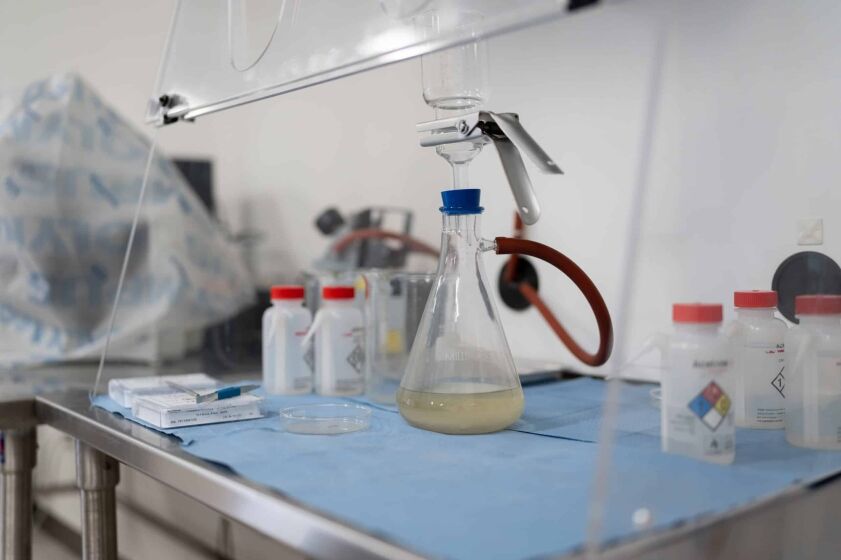
Millipore Analysis measures particulate contamination by extracting and collecting particles on a filter membrane for analysis. It is common in automotive, aerospace, and precision manufacturing, where particle size and count are defined cleanliness specifications.
Gravimetric Testing measures residual contamination by weight, particularly useful for evaluating oils, residues, and fine contaminants that may not be visible but still affect downstream performance.
Water-Break-Free Testing provides a simple, fast surface cleanliness check. A continuous sheet of water across a surface indicates it is clean; beading or separation points to residual contamination.
Dyne Testing measures surface energy to determine whether a part is ready for painting, coating, printing, or adhesive bonding. It answers the practical question: will this surface accept what comes next?
Microbial Testing is used in pharmaceutical and food manufacturing environments where biological contamination must be controlled, documented, and reported. Depending on the application, manufacturers may use ATP testing to verify the removal of biological residue, TOC analysis to measure organic contaminants, or EB testing to quantify extractable residues. Together, these validation methods provide objective evidence that the cleaning process consistently meets hygiene, product quality, and regulatory requirements
Each method produces objective data. Together, they replace assumptions with evidence.
How Better Engineering Approaches the Problem
At Better Engineering, the process validation conversation starts before a single piece of equipment is designed.
Engineers begin by understanding the application itself: part geometry, contamination types, cleanliness requirements, production rates, and downstream considerations. Whenever possible, actual production parts and contaminants are tested in Better Engineering’s applications laboratory, using the full range of validation methods: Millipore analysis, gravimetric testing, water-break-free testing, dyne testing, microbial testing (ATP, EB, TOC), process chemistry evaluation, and drying performance verification.
This testing identifies the specific process parameters required to achieve measurable cleanliness results, and it happens before system design is finalized, not after. Once the process is established, systems undergo factory testing and validation to verify performance prior to shipment.
The objective is not simply to build a washer. It is to engineer a cleaning process that consistently achieves a defined, documented cleanliness specification.
Start With Validation
Machine specifications should absolutely be part of any equipment evaluation. But they should not be the whole conversation, and they should not be the starting point.
The more productive question is: How will cleanliness be measured, documented, and validated throughout the life of this process?
Because manufacturers are not ultimately purchasing spray pressure, tank volume, or pump capacity. They are purchasing a cleanliness outcome. And the only way to verify that outcome, before you invest, and every time the process runs, is through validation.
Let’s Evaluate Your Application
Better Engineering helps manufacturers develop, test, and validate cleaning processes before systems are built. Using real parts, real contaminants, and measurable cleanliness standards, our engineering team works to ensure the process delivers the results your operation requires.
Submit a sample part, schedule a process review, or contact Better Engineering to discuss your application and cleanliness requirements.
