In industrial parts washing, cleaning performance is typically the primary focus. Spray pressure, chemistry selection, wash temperature, and filtration are all carefully evaluated during system specification. Drying, however, is often treated as a supporting feature rather than a controlled process step.
This assumption can be costly. Drying directly affects cleanliness verification, corrosion prevention, downstream process stability, and overall equipment effectiveness. In many manufacturing environments, parts leave the washer looking clean but still retain moisture in features that are difficult to inspect or measure. That residual moisture can quietly introduce variability long after the washing process is complete.
Proper drying should be considered an extension of the cleaning process, not a separate or optional function. When drying is engineered with the same level of intent as washing, manufacturers achieve greater consistency, reduced rework, and greater confidence in part quality.
Why Parts Drying is Required
Water remaining on a part after washing is rarely just water. It typically contains dissolved minerals, detergent residues, or contaminants that were removed during cleaning. If that moisture is not fully removed, those materials remain on the part surface as the water evaporates naturally.
Common consequences of inadequate drying include:
- Flash rust on ferrous components, even when corrosion inhibitors are used
- Water spotting that interferes with visual inspection or cosmetic requirements
- Residue formation that compromises functional cleanliness
- Moisture entrapment in internal features that migrates during storage or assembly
- Process delays caused by manual drying or extended dwell times
Drying is also critical for repeatability. A cleaning process that produces variable drying results can appear inconsistent even when washing performance is stable. This makes root cause analysis more difficult and can lead to unnecessary adjustments elsewhere in the process.
From a compliance standpoint, many industries require documented evidence that parts are dry prior to assembly, coating, or packaging. Without a controlled drying method, meeting these requirements becomes challenging.
What Parts Can Be Dried?
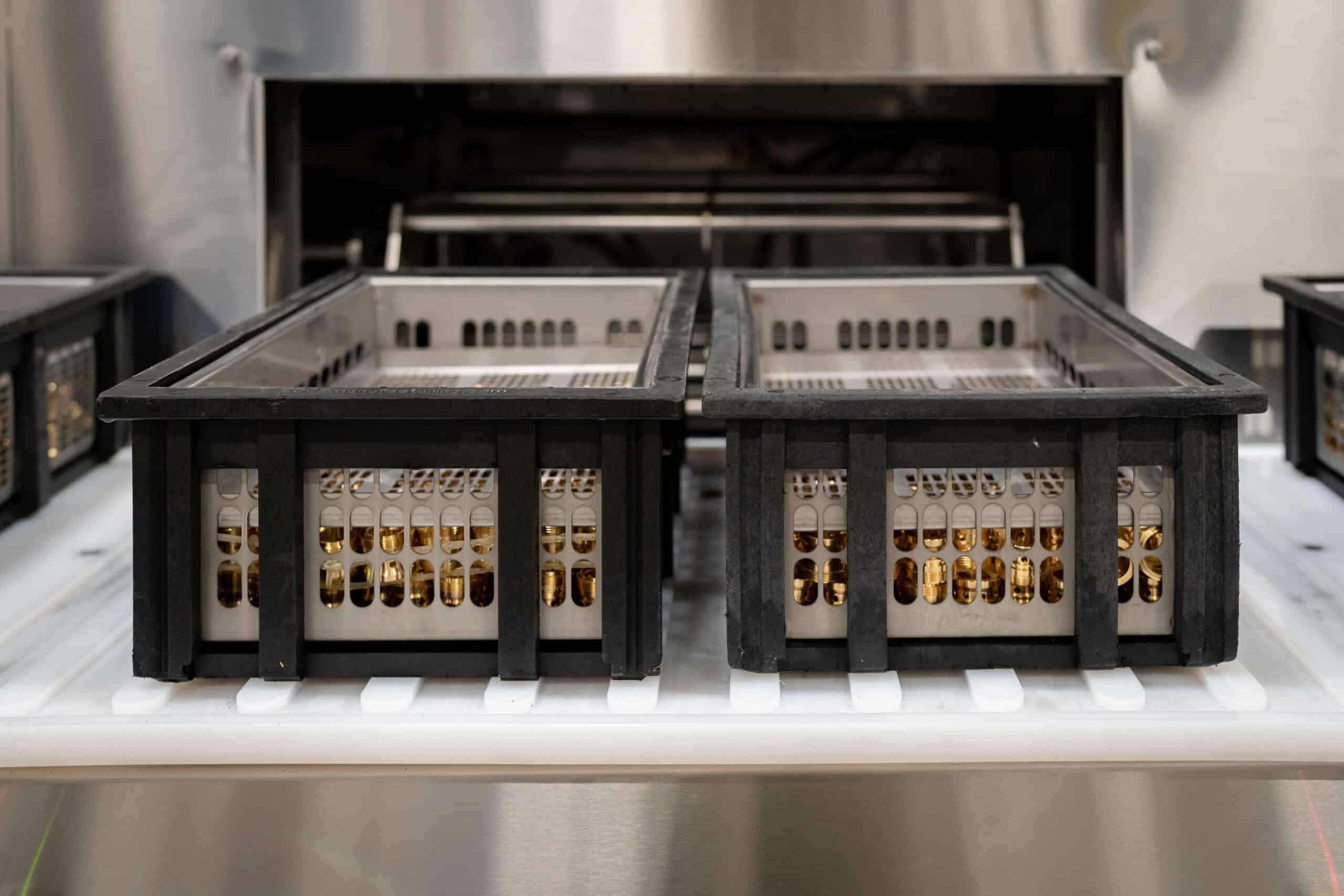
Most industrial components can be dried effectively when the drying method is matched to the part’s design and material. This includes:
- CNC-machined components with tight tolerances
- Cast or forged parts with complex surface textures
- Stamped or formed metal components
- Medical devices and surgical instruments
- Aerospace components with internal passages
- Automotive parts used in fuel, hydraulic, or braking systems
- Totes, bins, lugs, and other vessels used for storage or transportation
- Pharmaceutical tools used in production
- Waste containers used in the food and pharma industries
- Etc.
Challenges arise with parts that include:
- Blind holes or threaded features
- Capillary gaps between mating surfaces
- Long, narrow internal channels
- Assemblies with mixed materials
In these cases, surface-level drying may be misleading. A part can appear dry on the outside while retaining significant moisture on the inside. Selecting a drying method that addresses these features is essential to avoid downstream failures.
Material sensitivity also plays a role. Thin-wall components, plastics, and elastomers may require lower temperatures or longer drying cycles to prevent distortion or degradation.
What Are The Types of Drying?
Industrial parts washers use several primary drying methods, each suited to different applications and constraints. Understanding how these methods work helps prevent over- or underspecifying drying capability.
Compressed Air Blow-Off
Compressed air blow-off removes water through mechanical force rather than evaporation.
How it works:
High-velocity air is directed at the part using nozzles or air knives. The airflow physically displaces water from surfaces and pushes it out of open features.
Advantages:
- Rapid removal of bulk water
- Effective for simple part geometries
- No thermal exposure to the part
- Easily integrated into conveyorized systems or parts washer cabinets
Limitations:
- Limited ability to remove water from blind holes or internal channels
- High energy consumption associated with compressed air
- Risk of spreading contaminants if airflow is not properly managed
Compressed air blow-off is often used as an initial drying step to reduce the load on downstream drying processes or where partial dryness is sufficient.
Vacuum Drying
Vacuum drying removes moisture by reducing ambient pressure, which lowers the boiling point of water.
How it works:
Parts are placed in a sealed chamber where pressure is gradually reduced. As pressure drops, water trapped in small features vaporizes and is removed from the chamber.
Advantages:
- Highly effective for complex and enclosed geometries
- Removes moisture from internal passages and blind holes
- Lower temperature operation reduces thermal stress
- Produces consistent and measurable results
- Shorter cycle times compared to air-based methods
Limitations:
- Higher system complexity
- Typically batch-oriented rather than continuous
Vacuum drying is commonly used in medical device manufacturing, aerospace applications, automotive applications, and precision cleaning environments where internal dryness is non-negotiable.
Drying With Heated or Unheated Air
Air drying relies on evaporation driven by airflow, temperature, or both.
Unheated air drying:
Uses ambient or conditioned air to promote evaporation. Effectiveness depends heavily on airflow design, part material, air knife proximity to the part, humidity, and dwell time.
Heated air drying:
Introduces thermal energy to accelerate evaporation and reduce cycle time.
Advantages:
- Scalable for large or heavy parts
- Compatible with high-throughput systems
- Temperature and airflow can be tuned to the application
Limitations:
- Risk of overheating sensitive materials
- Less effective for deeply trapped moisture without targeted airflow
- Energy usage increases with temperature and volume
Air drying is widely used in general industrial applications where throughput and flexibility are priorities.
What Are the Degrees of Drying
Drying requirements are often described imprecisely, leading to misaligned expectations between equipment suppliers and end users. Defining the required degree of drying is essential.
Surface Dry: Parts show no visible droplets on external surfaces but may retain moisture internally. Suitable for handling or interim storage.
Functionally Dry: Parts are dry enough to perform their intended function without moisture-related interference. Often acceptable for certain assembly or testing steps.
Internally Dry: All external and internal features are free of residual moisture. Commonly required for precision assemblies, fluid handling components, and coated parts.
Bone Dry: No detectable moisture remains anywhere on the part. Required for high reliability, regulated, or contamination-sensitive applications.
Specifying the degree of drying upfront helps ensure the selected system meets both technical and operational needs.
Why Drying Deserves More Attention
Drying performance influences far more than part appearance. It affects corrosion resistance, cleanliness verification, process consistency, and downstream reliability. When drying is under-engineered, manufacturers often compensate by using manual processes, longer cycle times, or additional inspection steps.
By treating drying as a critical process variable rather than a default feature, manufacturers can achieve more predictable outcomes and reduce hidden costs. In many cases, improving drying effectiveness yields immediate benefits without changing wash chemistry or mechanical design.
A well-designed drying process completes the cleaning cycle and ensures that the cleanliness achieved in the washer is preserved through the rest of the manufacturing operation.
Ready to learn more about our rotary basket part washers? Contact us to learn more or request free, no-obligation parts testing.